Tuesday, February 14, 2012

Matthew Barney & Ari Marcopoulos

Matthew Barney & Ari Marcopoulos:


all images © ARI MARCOPOULOS

All the artworks in this story were presented in a show entitled DJED at the Barbara Gladstone Gallery (September- October 2011)

Right now there is a thrill of getting right into the creative bowels of a studio; a voyeuristic insight that will lead you to places gravitating towards the world of raw, un-styled visual story-telling (a far cry from the polish of conventional editorial shoots). So, thanks to ARI MARCOPOULOS, the Amsterdam-born photographer took pictures of his atelier visit of the iconic artist MATTHEW BARNEY in his studio in Long Island City (New York) a year ago. At the time, BARNEY was preparing his exhibition entitled DJED at the Barbara Gladstone Gallery, a show based on myths from ancient Egypt:

Matthew Barney’s studio is located along the East River, in an industrial part of Long Island City. He and his assistants dug a hole in the floor of his studio, jackhammering the concrete. Matthew wanted to build an Egyptian death chamber below his studio in order to film in it. But while they were digging, it became clear that the water table was too high, making it impossible to create an underground space. In addition to the water, there was oil and a terrible smell. It seemed wiser to close the hole.

The flooding in the photograph occurred during Hurricane Irene. Together with the artist Keith Edmier, I’d spent the night at Matthew’s place, where we waited for the storm to pass. The storm didn’t live up to the hype on the news. The next morning, though, we went to check the studio and saw that it was flooded, which was slightly traumatic. He lost a few things, but not many. We canoed around in the studio, surveying the situation. - by ARI MARCOPOULOS


Wednesday, February 1, 2012

Adam Frelin

Adam Frelin:


Adam Frelin

Work from White Line.

“A long line of fluorescent lights were strung along a steel cable spanning the valley between two hills on a cattle ranch in Wyoming. The line of lights slightly bowed to mimic the curve of the valley 50′ below. When seen in this natural context fluorescent light is peculiarly similar to moonlight, yet the shadows it created, and the manner in which the valley was illuminated, were almost supernatural in appearance. A similar version was commissioned by the American Embassy for the International House of Japan. “White Line (Tokyo)” functioned like an effects machine, transforming their Japanese garden into an eerie, psychedelic wonderland.” – Adam Frelin


Judy Chicago and Materials & Applications

Materials & Applications

Art Los Angeles Contemporary (ALAC) presented its third edition at the Barker Hangar in Santa Monica from January 19-22. The opening night of the fair was filled with drama and suspense as crowds gathered to watch artist Judy Chicago and participants from Materials & Applications transform twenty-five tons of dry ice into an environment of fog illuminated at dusk by road flares. This installation unveiled Sublime Environments, a recreation of the public art installation Disappearing Environments originally performed by Judy Chicago, Lloyd Hamrol, and Eric Orr in 1968. It also kicked off the eleven-day Performance and Public Art Festival sponsored by the Pacific Standard Time initiative.


Judy Chicago and Materials & Applications, Sublime Environment, 2012. Photo: Donald Woodman. Courtesy Pacific Standard Time.


robyn cumming

robyn cumming:

robyn cumming 1

robyn cumming 2

robyn cumming 4

robyn cumming 5

robyn cumming 6

robyn cumming 7

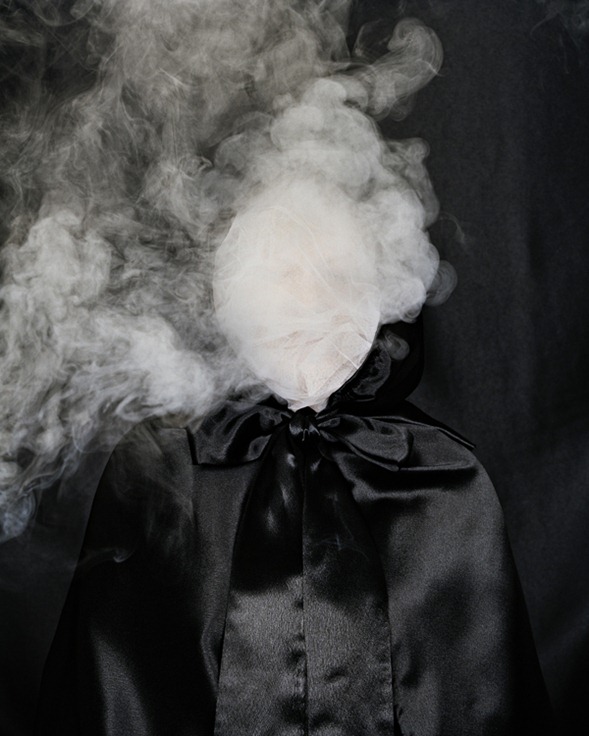
photography by robyn cumming


A Cathedral Made from 55,000 LED Lights

A Cathedral Made from 55,000 LED Lights:

A Cathedral Made from 55,000 LED Lights lighting installation art architecture

A Cathedral Made from 55,000 LED Lights lighting installation art architecture

A Cathedral Made from 55,000 LED Lights lighting installation art architecture

A Cathedral Made from 55,000 LED Lights lighting installation art architecture

The Luminarie De Cagna is an imposing cathedral-like structure that was recently on display at the 2012 Light Festival in Ghent, Belgium. The festival was host to almost 30 exhibitions including plenty of 3D projection mapping, fields of luminous flowers, and a glowing phone booth aquarium, however with 55,000 LEDs and towering 28 meters high the Luminarie De Cagna seems to have stolen the show. ( via stijn coppens, sacha vanhecke, sector271)


Henrik Menné

Henrik Menné:


Henrik Menné

Work from his oeuvre.

“Whether they are dynamic or static; sculptures by Henrik Menné are basically about process, balance and about organizing matter through both rigid systems and chance.

The major part of Mennés production consists of large-scale machines or arrangements temporarily put at work when exhibited – all sculptures are ‘in the making’ so to say. Their process is always silent, controlled and structured by repetitive movements as the machines transform a single material – plastic, wax, metal or stone – into peculiar objects. These soft-formed elements are seldom regarded as autonomous art works and destroyed or recycled when no longer on show.

Although closed and often self-referring, the system in which the process takes place both changes the environment and is sensible to changes in the environment. The instability of the physical context is therefore what causes important marginal variations in the shapes of the particular outcome.

The static sculptures by Menné contain the same immense effort and obsessive trait when it comes to putting forces such as gravity and well-known qualities ascribed to conventional materials into play. Another more conceptual approach is to be found in the few replicas of everyday objects, which are disturbed to the point where they loose the original function.

The intriguing low tech and analogue character of all works by Henrik Menné make visible the principle on which the individual system of the particular sculpture is organised. Despite this rational transparency works by Menné almost always appear as logically impossible and tremendously beautiful.” – Galleri Tom Christoffersen

via pietmondriaan

Jim Punk: exq=.s.te =n.c&de/s

Jim Punk: exq=.s.te =n.c&de/s:

Jim Punk is prolific and anonymous.

His website is encased largely in a cryptic
vernacular predominately of his own design: A laptop is rendered in ‘Oldskool’
ASCII style illustration graphics with the ‘keyboard’ displaying letters and
symbols (such as “&” or “n”) arranged in no particular order—as if Punk had
button smashed his keyboard and left the results to exist as is. There
are no direct title links, or any kind of straightforward archive list of
projects, instead it’s these arranged letters and symbols that when
painstakingly, individually clicked on, lead the viewer down into a further
maze of Punk’s own glitchy, early net art based work.

&é'(-è_çà)#+

azertyuiop^$¨£

qsdfghjklmù%*µ!§

<>wxcvbn,?;.:/~"{@

It’s this jumbled arrangement of symbols and
navigation confusion that has come to define Punk’s work over the
years. Responding to blog comments, tweets and even emails with this
seemingly incomprehensible employment of language, Punk avoids a certain
communicative regularity; rejecting the comprehensibility and clarity that
often lends itself to distinct individual recognition. Instead, Punk’s
non-linear, schizophrenic performance draws attention to the form language and
communication take, all the while disrupting standardized information flow and
producing an irregularity in the way we expect to approach and access content.

Punk's latest user generated project, exq=.s.te
=n.c&de/s
, is a glitched out Twitter feed that anyone can
post to. Utilizing a customized keyboard, comprised solely of unicode symbols, users can easily create
and tweet glitchy status updates. With currently more than 600 tweets,
Punk’s project works within the hyper consumptive pace of Twitter and utilizes
it as an alternative platform for formalized making. While Twitter
predominately exists as a website used to communicate in short, concise bursts
of text, with users usually promoting an event or revealing the banal
adventures crucial to their own existences, Punk’s Twitter demonstrates the
formal exploits of such a system; its purpose, re-purpose and what it is
capable of doing.

In a time when the capture and dispersal of
information seems crucial to maintaining productivity, Jim Punk decides that
playfulness and experimentation are still worth pursuing.

Follow and contribute here.


Josh Poehlein ‘Dark Cities’

Josh Poehlein:


All images © Josh Poehlein


Paul Chan

Paul Chan:


Work from The 7 Lights
from his exhibition at the New Museum. The videos and drawings from the exhibition can be seen here.

“This exhibition marks the American premiere of Paul Chan’s complete series “The 7 Lights,” offering a unique occasion to explore the practice of a New York-based artist whose work engages such fundamental themes as politics, poetry, war, death, and desire. Begun in 2005, Chan’s ambitious cycle combines obsolete computer technology with hypnotic imagery to create a series of enigmatic encounters with light and darkness. In the title, the word “light” has been struck through, drawing attention to its dramatic absence.


Tristan Perich

Tristan Perich:


Tristan Perich

Work from 1-Bit Symphony and Interval Studies.

“A return to the format of Perich’s lauded 1-Bit Music (described by the Village Voice as “technology and aesthetic rolled into one”), 1-Bit Symphony further reduces the hardware involved while simultaneously expanding its musical ideas. 1-Bit Symphony utilizes on and off electrical pulses, synthesized by assembly code and routed from microchip to speaker, to manifest data as sound. The device treats electricity as a sonic medium, making an intimate connection between the materiality of hardware and the abstract logic of software.

While 1-Bit Symphony is purely electronic in its execution, its contents reflect Perich’s long-standing interest in orchestral composition. Since the release of 1-Bit Music in 2006, Perich’s compositional work has combined 1-bit audio with acoustic classical instruments, providing insight into the conceptual and aesthetic relationships between physical and electronic sound. With 1-Bit Symphony, Perich brings this insight back into the digital realm, juxtaposing the grand form of a classical symphony with the minimal nature of 1-bit circuitry.” – Tristan Perich


nicola yeoman

nicola yeoman:

nicola yeoman 1

nicola yeoman 2

nicola yeoman 3

nicola yeoman 4

nicola yeoman 5

installations by nicola yeoman


Byoungho Kim

Byoungho Kim:


All images © Byoungho Kim


Doug Wheeler

Doug Wheeler:


Doug Wheeler

Work from his oeuvre

“As a pioneer of the so-called “Light and Space” movement that flourished in Southern California in the 1960s and 1970s, Wheeler’s prolific and groundbreaking body of work encompasses drawing, painting, and installations that are characterized by a singular experimentation with the perception and experience of space, volume, and light. Raised in the high desert of Arizona, Wheeler began his career as a painter in the early 1960s while studying at the Chouinard Art Institute (now the California Institute of the Arts) in Los Angeles.” - David Zwirner

via The New York Times